Public schooling occupies the lives of 90% of American youth (National Center for Education Statistics). With 35 hours per week spent in public schools — not counting extracurricular activities and homework — an education is practically a full-time job for any student, which raises a multitude of questions: Why is there no accountability in place for the people who organize class schedules, prepare students for college, and, above all, support students’ mental health every step of the way through the wild transitional period that is high school? Are guidance counselors able to continue filling these roles during COVID-19 school closures? Are there disparities in the quality of care students receive as a result of their socioeconomic status, sexuality, or religious affiliation, and are those discrepancies still present in the midst of the COVID-19 pandemic?
The Kentucky Student Voice Team’s research fellows struck out to provide a snapshot of how students in seventeen different counties were interacting with their high school counselors now and how this stacked up to their views before the pandemic put their in-person education to a screeching halt.
Originally, we focused our outreach and survey distribution on rural and low-income communities, as those are groups we suspected would be most impacted by the changes in counselor relationships as a result of COVID-19. Our research sample contained 348 Kentucky students, primarily in this region. Because of this, however, we only managed to reach 17 counties in Kentucky. As 17 counties are only a fraction of the 120 in Kentucky, we recognize our data cannot speak for the individual experiences of all of the state’s students, especially because these counties are geographically skewed to Eastern Kentucky. This does not, however, diminish the value of the stories from hundreds of students who willingly informed us of their experiences — positive and negative — with their counselors.
One accurate overview of a counselor’s ability to support students could be found by quantifying the number of services they provide; this was a natural starting point for us to begin comparing the quality of counseling before and after the pandemic. Students selected the services their counselors provided out of six options — scheduling, college aid, emotional guidance, mental health support, mediation, and other — both before and after closures related to COVID-19 school closures.
Overall, we saw an approximate 3.8% decrease in students given access to three or more of the aforementioned resources (pictured below in red), going from 20.6% to 16.8% of students over COVID-19 related school closures. However, individuals within the LGBTQ+ community reported only 16.4% of students receiving three or more services before pandemic-related closures. Among non-LGBTQ+ students, 21.5% received three or more services before pandemic-related closures. Post-closure, only 9.8% of LGBTQ+ students were receiving three or more services, amounting to a decline of more than double that of their cisgender, heterosexual peers.

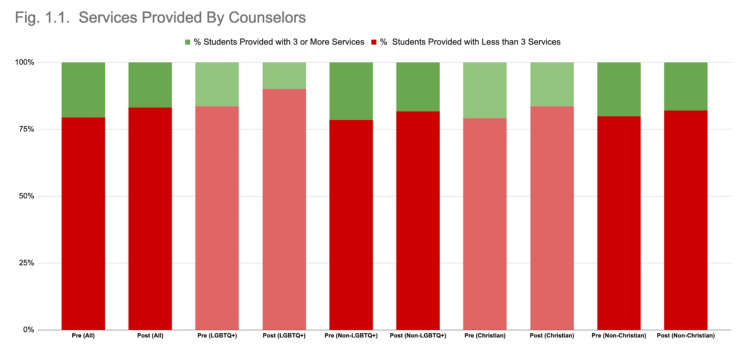
This disparity in services is made even more apparent by the answers to another question. When asked if they believed their mental health needs have increased over COVID-19 related school closures, just over 80% of LGBTQ+ students responded with a resounding yes, while students who did not identify as LGBTQ+ averaged in at about 51%. Queer students and non-Christian students repeatedly reported facing discrimination and a lack of resources from their counselors in our survey. Reflecting back to Figure 1.1, these communities consistently reported receiving fewer services from their counselors than their counterparts.


In summary, when asking the question of whether or not guidance counselors are providing for students given their dynamic needs throughout COVID-19 related school closures, the answer is a definitive no. As students’ mental health needs increase, the ability for counselors to provide for their student constituency has in fact declined. Once more, we are left to ask why.
As one student in our open response put it, “This is the first year that I have finally cracked under all the pressure, and all anyone seems to care about when I reach out is that I have missing assignments. Doing well in school is not an indication of intelligence, or even work ethic, in my opinion. If anything, it’s simply an indication of privilege.” Students who see themselves reflected in their guidance counselors — a career that is dominated by white, cisgender, heterosexuals (Robertson and Full) — are provided with more resources and report less of a need for mental health support over recent school closures.
This issue is systemic: guidance counselors are not capable of handling all the jobs given to them (Kim and Lambie), and they are not provided with adequate training to equip them with the tools to tackle issues predominantly faced by marginalized students (Robertson and Full). Less than 30% of districts provide professional training for these students’ needs, and counselors in grades 9–12 are outnumbered nationally 212 to 1 (American School Counselors Association).
With counselors spread thin and inadequately trained before the pandemic, students already in vulnerable positions are further neglected during the chaos of COVID-19 related closures and hybrid schooling. By failing the counselors, this system is failing all students.