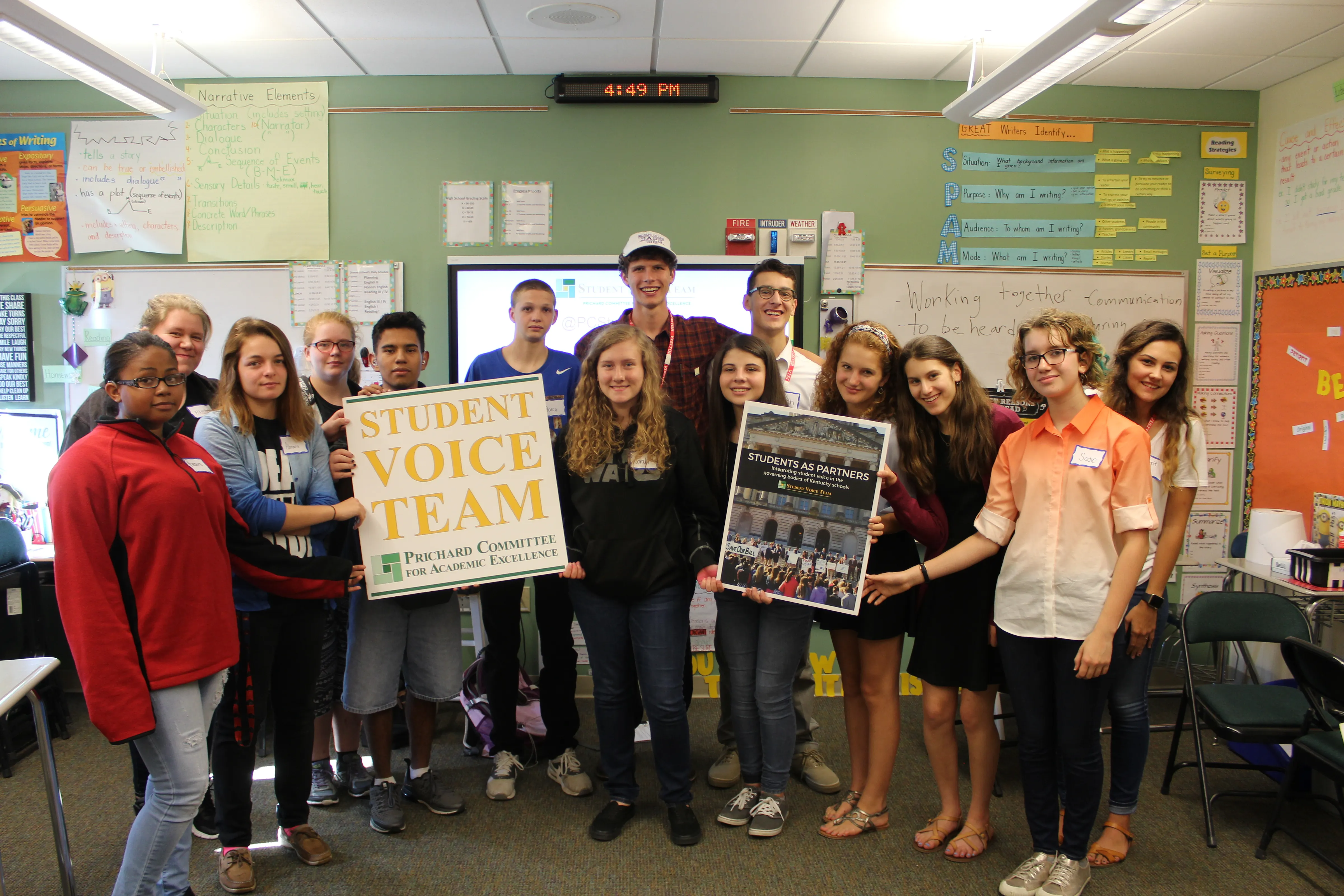
As part of our Students as Partners Listening Tour, the Prichard Committee Student Voice Team’s School Governance Committee has spent much of the school year facilitating workshops and roundtables with students across Kentucky. The goal is to share our research about integrating students in more meaningful ways in school decision-making and solicit local feedback on the dynamic between students and the school system.
Because we wanted to be intentional about targeting those less accustomed to being heard, we thought it especially fitting that our listening tour began at the Kentucky School for the Deaf (KSD) in Danville, about 35 miles southwest of Lexington. Established in 1823, the school is the first public supported school of its kind in the nation and currently educates 96 students from pre-K through high school. We are very appreciative of the staff at KSD who supported us in creating a safe space for students to share their opinions.
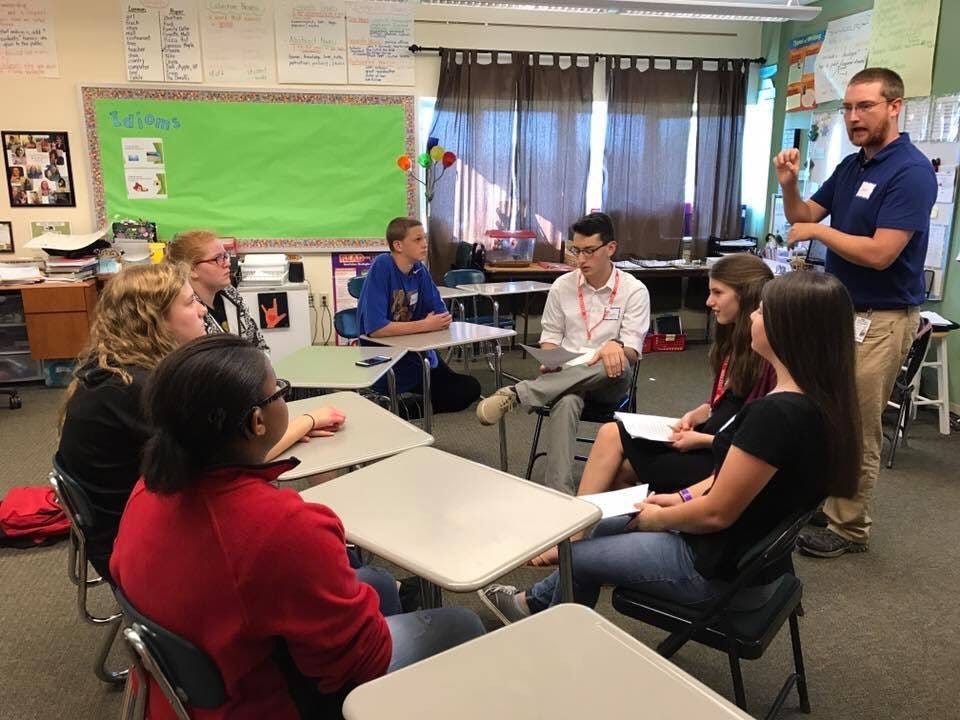
Below is an abbreviated version of a roundtable we conducted in September. Through a sign-language interpreter, four KSD high schoolers participated in the conversation with no other adult present in a KSD classroom. And while we do not claim that every student at the Kentucky School for the Deaf shares the same sentiments, we are grateful that Aaron, Alexandra, Sarah and Keura shared their personal truths with us.
Typically, when transcribing roundtables, we hear the voices of the participants and are able to label each speaker according to the sound of the voice that is speaking. But due to the unique nature of using sign language to communicate in this situation — and a lack of foresight on our part — we neglected to devise an alternative way to identify speakers and are not able to assign specific names for each comment. This mistake will serve as an important reminder for us to better accommodate students with different needs in the future.
Kentucky School for the Deaf Transcript Highlights
What would you like to tell us about your school?
It’s easier if the teachers are deaf because the students are deaf. So that way the teachers understand what the students are saying.
At KSD, I feel more involved here.
How were your previous schools different from KSD?
I couldn’t communicate. I could sign, but I couldn’t really communicate with my peers. But there is a lot better communication [here]. Communication is easier. At the hearing school, I was kind of stuck.
It was good education, don’t get me wrong. I had an interpreter there, but… and we had a couple other deaf students that were with me. But sometimes when they signed, I didn’t understand. And when I tried to ask them, it just wasn’t clear. It was hard.
I came here and learned so much more. I did learn a lot at the public school, but I feel like… but it wasn’t the same. I wasn’t treated fairly.
Most people here are deaf, so when we have discussions or opinions, we all brainstorm together, and I like that.
If [a student hasn’t] learned ASL or sign language, we try to help them out to break that communication barrier. That way, they can learn English and ASL better.
What about your perception as students is unique?
We’re very open minded…We’re very direct, being deaf.
Can you tell us at least one thing that is problematic, one thing you’d like to see changed?
More advanced classes.
We go to the public school for honors English. [The English class here,] it’s just more simple. It’s limited. We learn the same things. There isn’t any new information there. So, like with the honors class, there’s a whole lot more information that they give us.
Do you enjoy going to the public school?
I wish it was here. Because again, I’m alone whenever I go over there [to Danville High School, around the corner from KSD]. Here, I feel connected.
How are you treated at the public school?
At the public school, I feel everyone avoids me, in a way, because I’m deaf, and they don’t know how to communicate with me.
What can you tell us about your challenges at KSD?
The teachers need to make sure all the students comprehend the material before moving on. I feel like the students need to be on the same page before we can move on.
How can the teachers accommodate the problem?
They teach to the less [advanced] students, so that way, they understand, and the other students who, I don’t know, it feels… It’s almost not interesting. I want to learn. I want a good education. But I’m waiting, and I’m waiting, and I’m waiting for the teacher to teach to those other students.
I want to be mixed in with other students and other grade levels, to be more of a challenge.
It can be a little bit slow. And we just kinda deal with it. I want to learn, I’m ready.
It’s almost monotonous.
[At] public school, I’m involved. We’re moving and everything, and here, it seems like it takes a couple months to get a topic across and then we move on.
We have some new students, but I want other material. Bring in something new. Something I haven’t heard of. So that’s what I want in that class.
Do you guys want there to be more honors classes at KSD? Not at the public school?
Higher level would be nice, that’s what I’d prefer. Something a little more of a challenge.
Is there tension between you guys, or is it a nice environment where you guys get along?
There’s more tension than, you know, friendly faces.
I’m closer with other students than the teachers.
Do you enjoy the activities with your friends?
It’s limited. Sometimes drama can ensue. So I don’t like that too much. Because it’s a smaller school, there probably is more drama that goes on.
Do you think you should be able to voice your opinions about what you study or what you do?
Our opinions can help.
If our opinions are different from the teacher, they typically don’t listen to us or won’t respect our opinions.
What kinds of things do they say to you that makes you think they don’t respect your opinions?
If we say someone is being rude, the teachers say that maybe we have the wrong information or something. They say, “No, it didn’t go down that way. It didn’t happen like that.”
So do you guys think that principals and teachers listen to students at your school?
No.
None of you guys do?
No.
Why not? And what can be done to fix that? That’s like the meat and potatoes of this. This is what it’s all about.
Because they’re all hearing. They don’t know deaf culture.
Well, not a lot of people understand deaf culture. I mean, some of them do, but not most of them here.
Some of the staff, they kinda push us away in a way, because we’re deaf and they think they’re smarter and they can throw out their opinions, and that when we express our opinions and how we feel, some of the staff will just disregard it.
Do you feel often when you try to express your opinion that they don’t listen or don’t do anything?
Yeah.
I’ll voice my opinion, and they’ll say, “No, you need to respect the teacher. You need to be nice to them.” But I really wasn’t saying anything mean. I was just saying we’re deaf students, and we need a deaf staff. I don’t want to offend hearing people, but at the same time, they don’t know deaf culture well enough. Sometimes it’s not only hearing people. It can be the deaf staff too…
What can be done to change that?
One time, some juniors decided to…voice our opinions with the principals and the administration at the time. So we had a big meeting over that. And they really told us that we could back off, that we weren’t allowed to voice our opinions. And that if we did, we could get in trouble.
What would you write if you were sharing that with your principals and teachers? What would you say is wrong?
I’d almost go around them and give it to the higher up administration. Let them know the struggles we have…and give it to the people that are higher up. That way they can tell the principals and teachers.
What would be in the letter?
[We would] tell them that we feel like our opinions in this school, they don’t count. That we feel limited here.
I feel like we don’t get to learn a lot about life lessons. They really don’t teach us a lot about that.
Is there a lot of bullying?
Yeah.
Does the school do anything about bullying?
Well sometimes, it’s like if they see something happen, we go and tell the correct people and then it seems like they put it off before they move on to find out what happened or find a resolution.
Some of the staff, you know, they don’t believe us. Like, “Hey, we saw. This is proof.” And we go and tell them and they’re like, “No, that didn’t happen.” Some believe us, and some of them don’t.