
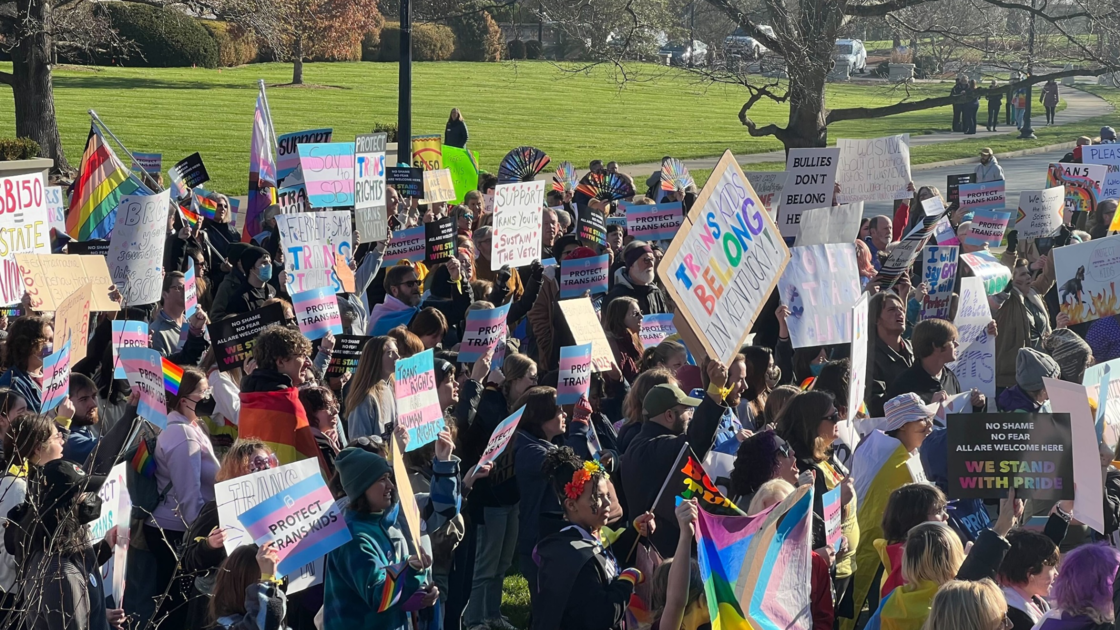
During the week of Nov. 16, Fayette Circuit Court Judge Julie Muth Goodman’s courtroom heard from three Fayette County families who are suing the Fayette County Board of Education and the Kentucky Attorney General’s office over anti-trans legislation.
What the Lawsuit Claims
In the lawsuit, John Doe et al. v. Fayette County Board of Education and Kentucky Attorney General Russell Coleman, Fayette County students and families allege that there are long-term mental health, physical health, and social issues that stem from implementation of Senate Bill 150, enacted on March 29, 2023, after the supermajority in Kentucky’s General Assembly overrode Governor Andy Beshear's veto.
Senate Bill 150 prohibits gender-affirming medical care for minors, and in schools, restricts gender-affirming restroom access, mandates pronoun use based on biological sex, bans instruction on human sexuality and gender identity across all grades, and mandates parental notification and consent for student health services and biological sex education.
The plaintiffs allege that Senate Bill 150 violates students' educational rights under the Kentucky State Constitution.
A Motion to Dismiss, Denied
On Nov. 16, The New Edu was present as the defense, representing the Fayette County School District and Kentucky Attorney General, presented their argument and sought a motion to dismiss.
The defendants filed a written and oral motion to dismiss on the grounds that “any offenses stated by the plaintiffs were “one-offs” and clearly not proof of any sustained injury, according to FCPS attorney, Susan Sears.
Sears concluded her defense by stating that there is no relief that FCPS can provide without failing to follow the law and that the district should not be punished for being in legal compliance.
The attorney representing the plaintiffs, Clark Johnson, argued that “just following orders” is not valid reasoning, as there are democratic ways to approach the legislature for change, of which FCPS has not attempted since SB 150’s passage. Johnson summarized the harms the witnesses had demonstrated and related each instance back to how the district should be seen as a partial culprit.
As reported by the Lexington Herald-Leader, students and families allege that SB 150 has restricted students’ abilities to participate in school-related activities and use restrooms they previously were able to access without issue. One claim mentioned was a substitute teacher making harmful comments to a student.
Since SB 150’s passage in 2023, there has been reporting quoting experts who said the bill would harm students’ mental health.
Upon hearing each side in regard to the motion to dismiss, Judge Julie Goodman failed the motion, allowing the case to proceed.
The Attorney General's Defense
As the trial continued, the Attorney General’s defense, Aaron Silletto, presented their argument. Silletto maintained that, first, the presented incidents were “one-offs” and were resolved independently by the schools. Second, Silletto argued that “misgendering in and of itself is not a bullying offense,” and since FCPS had not updated their bullying policy to include misgendering (addressing someone with words that do not match their gender identity) after the passage of SB 150, it would not necessarily qualify as bullying.
Silletto also addressed the constitutional argument of free speech, stating that the law does compel disagreement speech, but to mandate otherwise would be to potentially force staff to use speech that contradicts their personal beliefs.
Silletto argued that while some harm may come to the 3% of young people who identify as trans in the United States, there is little research on the effect of an altered status quo on the 97% percent, and it should be left up to the legislature to make an accurate interpretation.
The Plaintiffs Push Back
After Silletto finished his opening argument, Johnson challenged each prior argument, beginning with the presumed lack of data on the 97% that Silletto introduced.
To this, Johnson informed the court that SB 150 was unprompted and that “as there was nothing that the legislature was directly responding to in the creation of this bill, it is to be implied that there was no harm to the 97% in the first place.”
Johnson said that the defendant is essentially protecting the 97% from no formerly identified harm and that in doing so, the harm to the other 3% of young people increased greatly.
Johnson recalled that two prior expert witnesses, Dr. Brown and Dr. Brady, had spoken at length with evidence of the explicit and implicit long-term and short term harms of misgendering. He closed his rebuttal by referencing the 1989 landmark KY Supreme Court Case, Rose vs. the Council for Better Education and concluded that the capacities of a constitutionally guaranteed adequate education are clearly not upheld as seen by the case thus far. (In 2025, the Kentucky Student Voice Team filed a lawsuit against the Commonwealth of Kentucky asserting that the state has failed to uphold the right to a quality education as established by Rose v. Council for Better Education.)
Students and Staff Speak
According to reporting from the Lexington Herald-Leader, a school district employee testified that SB 150 created confusion and fear among staff; a seventeen-year-old student identified under the pseudonym “Child Noe” also testified about the impact SB 150 has had on his experience at school.
“I have watched people sit in a room and argue about who I am and who my parents are,” he said, as reported by the Lexington Herald-Leader.
“They sit in a room and decide I am not smart enough to determine where I relieve myself. It is hurtful, it is shameful,” Noe said.
The Herald-Leader reported that though evidence concluded on Friday, Nov. 20, Judge Goodman’s ruling could be several weeks away.
Caroline Segebarth is a junior at Paul Laurence Dunbar High School in Lexington, Kentucky.