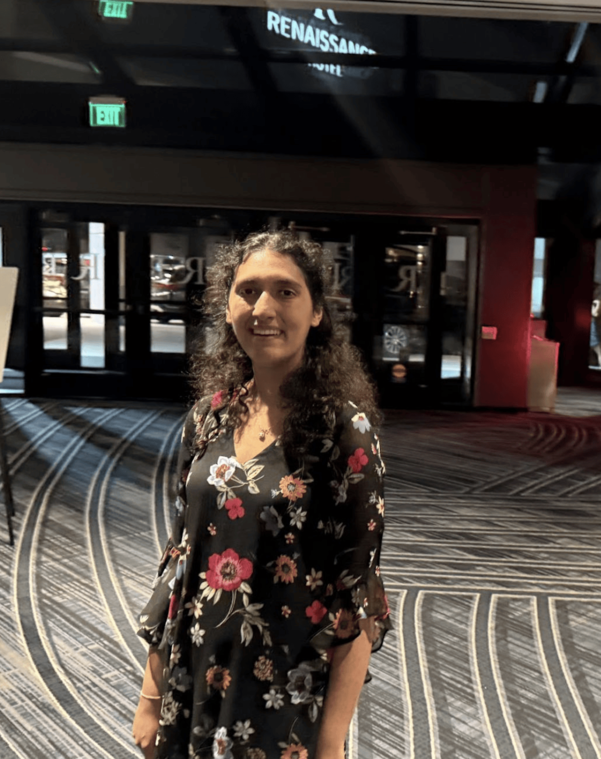

Dhyani Vashi is an Indian immigrant who came to America a year and a half ago. We interviewed her at Fern Creek High School, where she is a senior.
Below are excerpts of Dhyani from the roundtable. These quotations detail Dhyani’s experience as an immigrant and as a student in Louisville, Kentucky.
[Speaking about what brought her and her family to the U.S.]
“Basically, we moved from India because of my education. Everything was fine, economically and everything. If we want to have a better education, like if I wanted to go to medical school in India, it cost too much money. And we don’t get any help from the government like we do over here, like FAFSA and scholarships.We were from a middle-class family and we could not afford it. The other thing was that the education system in India is very different from here. It’s very hard, so it’s kind of depressing for students over there. It was really tough for me, so my parents decided to move over here. My uncle and my grandma were already here, so we came over here last year.”
What were your first impressions of the US when you arrived versus what they are now? What’s your first language?
“I speak Gujarati at home, and I’m multilingual. My uncle used to say good stuff about education. Don’t worry about education; you’ll always get good opportunities no matter what, and you’re a good student, so you’ll get into whatever you want, it’s not like in India. So I had pretty good impressions.”
What is it like being an immigrant or refugee as a student? What is it like being new in a place and how does that affect your education? Do you feel like it’s difficult at first?
“It’s hard to be an immigrant student. Not in terms of education, but in terms of getting used to the things that an American student goes through. We are different from them; we have different mindsets, norms, culture. We’re like the odd one out over here. I was told by one classmate that immigrants like us are stealing their opportunities and [money].”
How’d that make you feel?
“I felt really bad. I was like, your government is trying to help us, and I really appreciate it. I’m not illegal or undocumented, and even if I was undocumented, if this country has a power to help someone, then why don’t you want to help them? I know the U.S. has the power to help so many families over there. There are so many families dying of hunger in refugee camps. If you had a look at refugee camps in various places, you’d realize it’s hard to be an immigrant. We’re not here to steal your things; we just need your help.”
Did you feel bullied when that person said that? What was your reaction?
“I didn’t feel bullied, but I felt that I wanted to know what Americans think about immigrants, because I’ve met so many Americans and they all have different opinions. We were having class discussions, and [the classmate] just kept his point of view. I didn’t have issues that he kept his point of view; maybe it’s part of his way of thinking, his family, his environment, I don’t know.”
Was it hurtful?
“Kind of, because he wasn’t thinking, he didn’t know what immigrant life looked like. It’s not his fault, but he should have thought before he spoke.”
Do you have thoughts about what you’ve been hearing politically or from people in school?
“President Trump thinks that Indians are stealing jobs from Americans., I don’t know why he says that. We’re getting jobs because we’re gifted, we work hard. Like any other American students, we also study., Wwe work hard to get that job. It’s not like we’re getting it because we’re a minority. It’s difficult, it’s scary, because he tries to kick out immigrants. They’re banning Muslim immigrants because they think they’re terrorists, but I don’t think that’s the right way. All he’s doing is making America look racist, and I don’t think that America is racist.”
If there’s one thing that you want American students to know, what would it be?
“That you guys are great, that you’re allowing us to share your things. But don’t treat us like we’re unwanted. We’re here because we need help, and it’s really nice that you guys are allowing us to be part of your family, because immigrant life isn’t easy. When you’re an immigrant, you’re not part of your country or the country that you’re in. When I go back to India, they’ll be like, “You’re American now; you don’t belong here.” And when I’m here, they’re like, “You’re Indian; you don’t belong here.” So we’re of nowhere, and it’s really hard to be an immigrant.”
[Speaking on the impact of being an immigrant]
“When I came here, I didn’t have any knowledge about this situation, and how this education system worked, so I was just given one schedule, and there was one senior girl who showed me my classes. After that, I had no clue where I should go or who I should talk with. I struggled in every class. In my government class, my teacher didn’t tell me anything. I came in in the middle of the year, so I missed a lot of stuff, so I didn’t even know what to do. She just handed me an assignment and was like, “You’re supposed to do that.”
“I had a really hard time and had to figure out everything by myself. I had to go to the counselor every day, and she tried to help me, but I think that help wasn’t enough. I talked to some of my friends that were out of the school, and they tried to help me. They told me about AP classes, the ACT. I hadn’t known I had to take the ACT for placement, and I hadn’t known how important it was. I struggled a lot when I got here. But the good thing is that I got some teachers who really cared about me… who always helped me and tried to make me comfortable.”
[Speaking on her experience in ESL classes]
“When I came here, [the teachers] could have told me how the system runs and what I should do. They could have explained stuff that I never knew. They could have told me about the ACT and AP classes.”
Where do you want to be 10, 20 years from now?
“After graduating from high school, I’m going to college, to U of L, and after that I want to go to med school.”
What was the one question that we should have asked, that we missed?
“You could ask what was their life like in their country, and how was their life over here? And you could spread it, because maybe it could change people’s thinking about immigrants and their struggle.”
What would be your answer to that question?
“When I came over here, I was hoping for so much and had a really good image of America. But after coming here, I realized that we’re unwanted by some of the people, and that really makes me sad because it’s like someone telling me that you were just dreaming up until now, and that it’s a nightmare, not the daydream you were thinking of. So you should be careful what you say before you hurt someone’s feelings.”
This interview was conducted by Zachariah Sippy, Emanuelle Sippy, and Pearl Morttey on March 10, 2017.
It was transcribed by Sadie Bograd and edited by Emanuelle Sippy.
This piece is one of many in the Forum’s Refugee and Immigrant Series. These students have inspiring and sometimes heartbreaking stories, but their voices are all too often overlooked. Over the course of the past few months, the Student Voice Team has spoken with refugee and immigrant students to not only gain a better understanding of their personal experiences but also hear their take on our new administration and the worldwide refugee crisis.