In the early hours of the morning of October 16th, 2016 in Lexington, Kentucky, Trinity Gay, daughter of Shoshana Boyd and Olympian Tyson Gay, happened into the middle of a gunfire exchange, caught a bullet to her neck, and died at the all-too-young age of fifteen.
Administrators at her school, Lafayette High School in Lexington, Kentucky, responded as they saw fit. They held a vigil, created a memorial in remembrance of Trinity, invited her father to speak to the school, shipped in grief counselors.
The community mourned.
An hour after Trinity was shot, someone else, a twenty-seven-year-old black man named James Augustus Blair, lost his life to a bullet. News coverage amounted to precisely six lines.
Four days after Trinity was shot, Lafayette students took the PSAT.
A few weeks after Trinity was shot, Lafayette science teacher Susan McLaughlin-Jones approached three of her students — Shana Berryman, Shermane Cowans, and Te’Osha Raglin — all of whom had been friends with Trinity. McLaughlin-Jones was a regular attendee at the annual University Council for Educational Administration conference, and she saw an opening for the girls to talk about their experience with trauma at school at this year’s conference, the theme of which was student voice.
The girls tentatively agreed to do so, reticent to talk about such personal matters in front of such a large crowd. “At first, it was like eh, yeah, I guess,” Raglin tells me. But they went through with it, simply out of respect for Trinity.
Three months after Trinity was shot, another child, a freshman at Lafayette died in a shooting. Someone requested a moment of silence on the morning announcements. Students whispered.
“Iknow a lot of people who died.” Cowans says this with an uncharacteristic flatness, launching into a horrifyingly lengthy list of names and causes of death with dizzying speed. “All this death is constantly happening… it’s more than just Trinity.”
And though at first, the three girls agreed to present at the conference to honor Trinity’s memory, the message of their presentation quickly expanded to encompass far more.
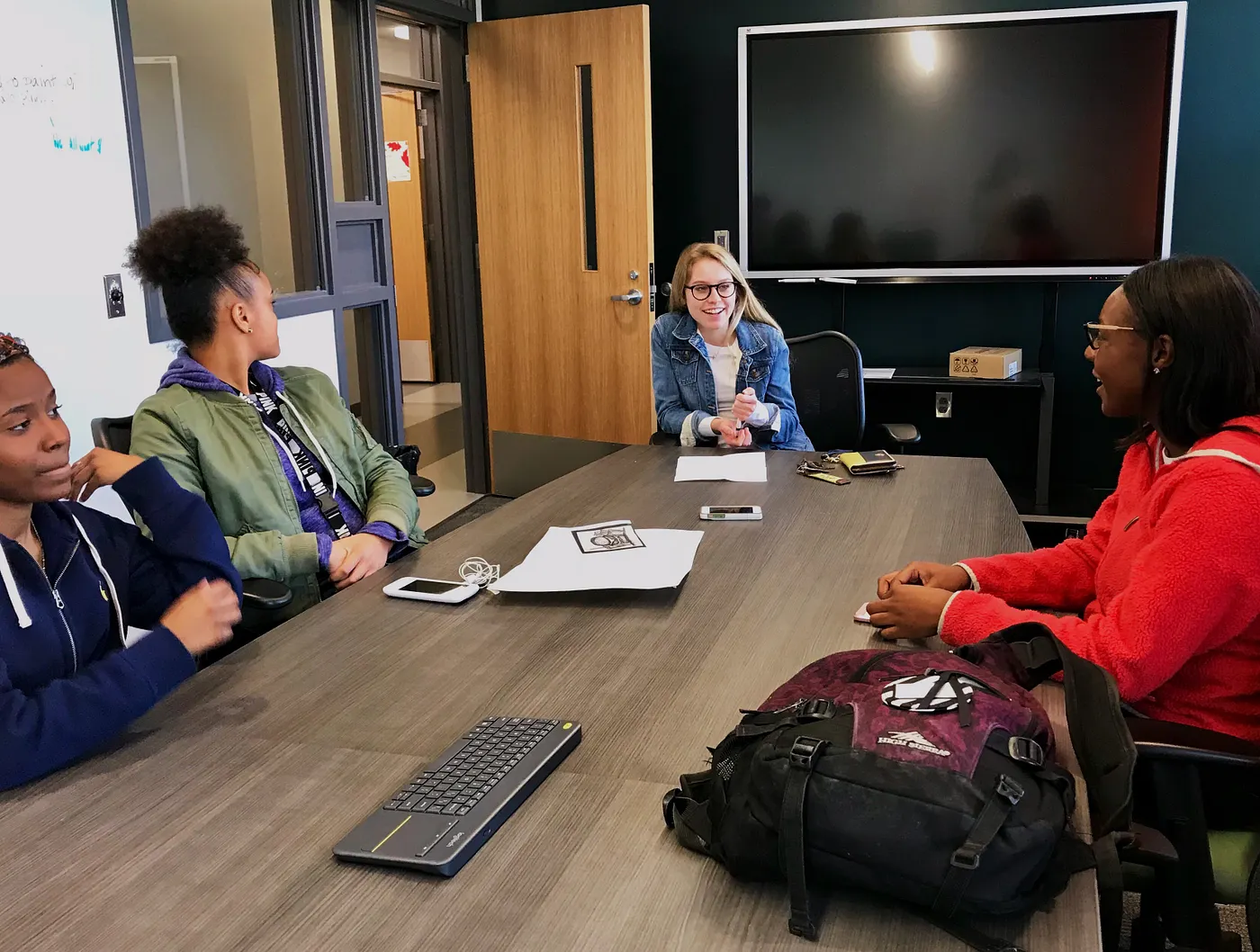
“I wanted them to see how much death we have to deal with, as sixteen year olds,” Cowans explains. “I want them to see that there’s deaths every month, every month someone’s dying.” She gestures to her friends sitting around the table. “She has deaths that I haven’t heard about, and she has her own deaths, and I have my own deaths.”
When the girls sat down to write down the names of peers who had died, they came up with a list of twenty-five names, enough to fill the attendance roll for a high school English class.
“I would hear gunshots every day when I was little. One day, across the street, someone got hit with a brick in their head and they died.”
“In sixth grade, my cousin was shot and killed… It hit me because it was family, but it didn’t hit me because I didn’t know him. Then I got to high school, and I hear about all these people dying.”
“One of [my brother’s] friends, he turned up his music really loud and he shot himself so his parents wouldn’t hear him.”

“I was going home from the bus stop probably a month ago, I was going down the street, and he was going up the street, and he stopped in front of me and put out his thing and started playing with it in front of me. And I was like ‘Oh my god’ and sped-walked home.”
“When I was getting off the bus, our bus got shot with a BB gun, and it cracked the window.”
“Last year, I was on my way home from school, on the bus, and this kid comes up to me, he had his hand under his shirt, and he pulled out his gun on me… My first response was to laugh because I was so nervous… He was like, “If you don’t give me your wallet right now, I’m going to press the trigger.’ So I tossed him my wallet.”
McLaughlin-Jones, who had been quietly observing as the girls spoke, occasionally prompting them to share a relevant story — “what happened on the school bus the other day?” — now interjected, “And we want them to do Algebra on Friday.”
These girls sit in class, and they see numbers and words on a screen, just as they are supposed to, but they also see shattered skulls and pointing guns and the faces of friends they’ll never see again. They take their books home, but they are prepared to drop them if they need to run. And they pick up their pencils and complete their tests, but they do so steeped in a cocktail of cortisol, sitting in a classroom of ghosts.
The choice between learning and surviving is not a hard one to make.
If you didn’t — as I didn’t — know that black kids, even black kids in small towns like Lexington, KY, often must cope with such trauma, it’s probably because they don’t talk about it.
“These girls, they don’t share this because they don’t know who is actually going to listen,” McLaughlin-Jones explains. “And if they do listen, is the response going to be more negative than what they already get?” She draws a parallel to the #MeToo moment, which has uncovered the alarming ubiquity of sexual assaults previously kept hidden because the victim did not want to be The Girl Who Was Raped. Talking about the death of a friend forces them into the threadbare role of The Black Kid Who Was Shot.
Berryman says bluntly, “When you say someone got shot, they’re not really surprised.”
So they don’t say it. And they don’t want to talk about it. When I asked the girls if they would use the services of an in-school therapist, their response was an immediate and resounding “No.”
They rarely even discuss these deaths with their friends and family. “People try to cover it up,” Raglin says.
“I’m one of those people. I don’t like when people feel sympathy for me. I like to handle things on my own.”
Berryman agrees, adding “You wouldn’t want them to hurt like you are hurting.”
This protective mindset is both understandable and admirable, but it also places an undue burden on the bearer of the trauma. “If it comes to mental illness, like if I’m feeling depressed, I just want to suck it up because I’m tougher than that. There are certain things I can vent to [my mom] about, and there are certain things that I can’t vent to her about,” Raglin tells me. So instead, she paints on a brave face.
“There’s all this hurt going on in these families, and they don’t want to talk about it because they want to protect each other,” McLaughlin-Jones says.
But now, sitting around a conference room table and spilling feelings, there’s a sense of release. “Talking about this makes it easier,” Cowan tells us. “When my brother was in high school, his friend killed himself. So when my friend died, I wanted to talk to him about it, but I was too scared because I didn’t want to bring up his emotions. If he cried, I would have cried.”
The friend she’s referring to, Keiarie Russell, killed herself last February, a suicide that was both tragic and entirely unexpected. Though it was by no means her fault, Cowan feels partially responsible. “I had sad thoughts, like wanting to kill myself, when I was little,” she shares. “So when Keirarie died, I thought, how did I miss it? What did I not see? Because she thought she was alone… When you’re depressed, you feel so alone, like you’re not there, like you’re invisible… And I’ve been there, I could have talked to her about it, I could have made her feel better, but I didn’t.”
She could have. But she could not. Because Russell didn’t share.
Past attempts to address the issue of trauma in schools have failed, not for lack of effort but for lack of cultural sensitivity. All three of the girls have had less than satisfying experiences with mental health support in school: Cowan spoke to a teacher when she was going through a rough time, only to be humiliated when he retaliated with what she viewed as a well-meaning, yet outsized response; Raglin visited the school counselor when she was bullied for her dark skin but left with her insecurities unassuaged when the counselor reassured her that she “go[es] to the tanning bed to get that dark;” and Berryman avoided the grief counselors shipped in by her school after Trinity’s death because she “knew they were just going to say ‘it’s going to be okay.’”
The solution, the girls say, is to foster student-teacher relationships like the one they share with McLaughlin-Jones. They have always felt like they could go to her for guidance or comfort; “She would make that more important than the content we were learning, but she would still give us extra help to make sure we were not failing or anything. And I feel like all teachers should have that relationship with their kids because I feel like I could talk to her about just anything,” Raglin says.
It may seem counterintuitive to suggest that effective teachers give up some of the rigidity in their lesson plans in exchange for a better understanding of their students. But excellent instruction can only be excellent if students do their part in processing the material, and students have a hard time valuing information relayed by someone who doesn’t value them. Furthermore, copious research connects a comfortable learning environment to improved student outcomes. When students feel comfortable, they are more likely to ask questions in class — Raglin says that if she “feel[s] the teacher getting frustrated, [she] just stops asking questions” — and take risks inherent to learning.
Beyond improving students’ performance in the classroom performance, strong student-teacher relationships provide students with a much-needed support system, someone to talk to who is not their parent, not their peer, and not a stranger. Teachers cannot truly prepare their students for the future without meeting them at the shaky foundations of their present. When teachers see students as people, they can understand the challenges they face outside of the classroom. And when students see teachers as people, they are less likely to misbehave.
McLaughlin-Jones says that the kids who on a daily basis fear muggings and gun violence are the “kids who are distracted, kids who are chatty… These girls talk, and I think that’s one of the ways they really get the energy out and process, because I think they’re processing a lot of this stuff verbally, and it comes out as talking. Which the school then turns around and says, ‘This is a discipline problem.’ The teachers don’t see what the noise and the back-chatter is all about.”
Raglin, Cowans, and Berryman are impossibly young to be so impossibly old. They told their stories in a serious tone, clambering to speak over one another, and then receding to allow someone the floor, a worn rhythm reminiscent of the fits of gossip to which my high school friends and I dedicated ourselves with a passion. But these girls did not speak of the outfit of a mutual friend, or the nerve of a teacher, or the intentions of a prospective love interest. They spoke of ringing bullets, of empty seats, of a sadness so great that they fear if they open their mouths, it will pour out and infect the ones they love.
In a state where only sixty percent of public high school graduates enroll in college, all three girls plan to further their education. It’s all too easy to forget that they walked the road to college on a path of quicksand rather than pavement. I am impressed by their level-headedness, their perseverance, and their ability to honor the death of their friend in a way that also calls attention to the countless others who receive no vigil, no speeches, just a few lines of obituary and pints of tears shed in solitude.
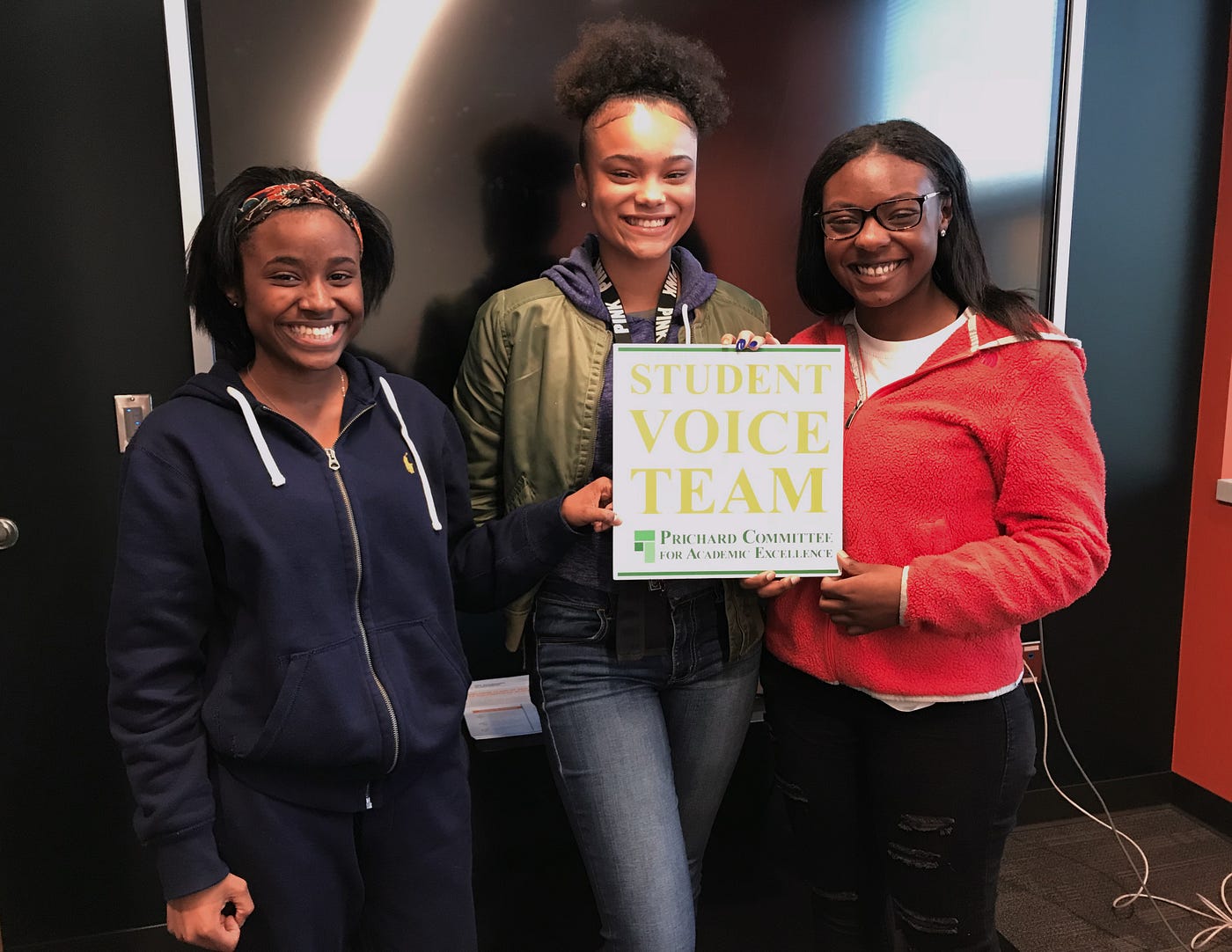
They have presented an academic research paper they co-authored with McLaughlin-Jones to audiences in Colorado and all across Kentucky about gun violence and school trauma, using Trinity as an example of the grief guns can cause while contextualizing her death with statistics and anecdotes demonstrating the crushing ubiquity of shootings. In the future, they plan to develop a curriculum that can be presented to middle schools across the nation, urging students to ignore the deceptive lure of power which guns provide.
It’s a message that may not resonate with everyone — the girls have presented before audiences whose closest encounter with a gun has been through the pixels of a television screen — but it’s a message that should be heard by everyone.
And to people who have never been the subject of a gun’s glare, Cowans shakes her head. “Your life is so different.”
Eliza Jane Schaeffer is a sophomore at Dartmouth College from Lexington, Kentucky and a member of the Prichard Committee Student Voice Team.
Press enter or click to view image in full size