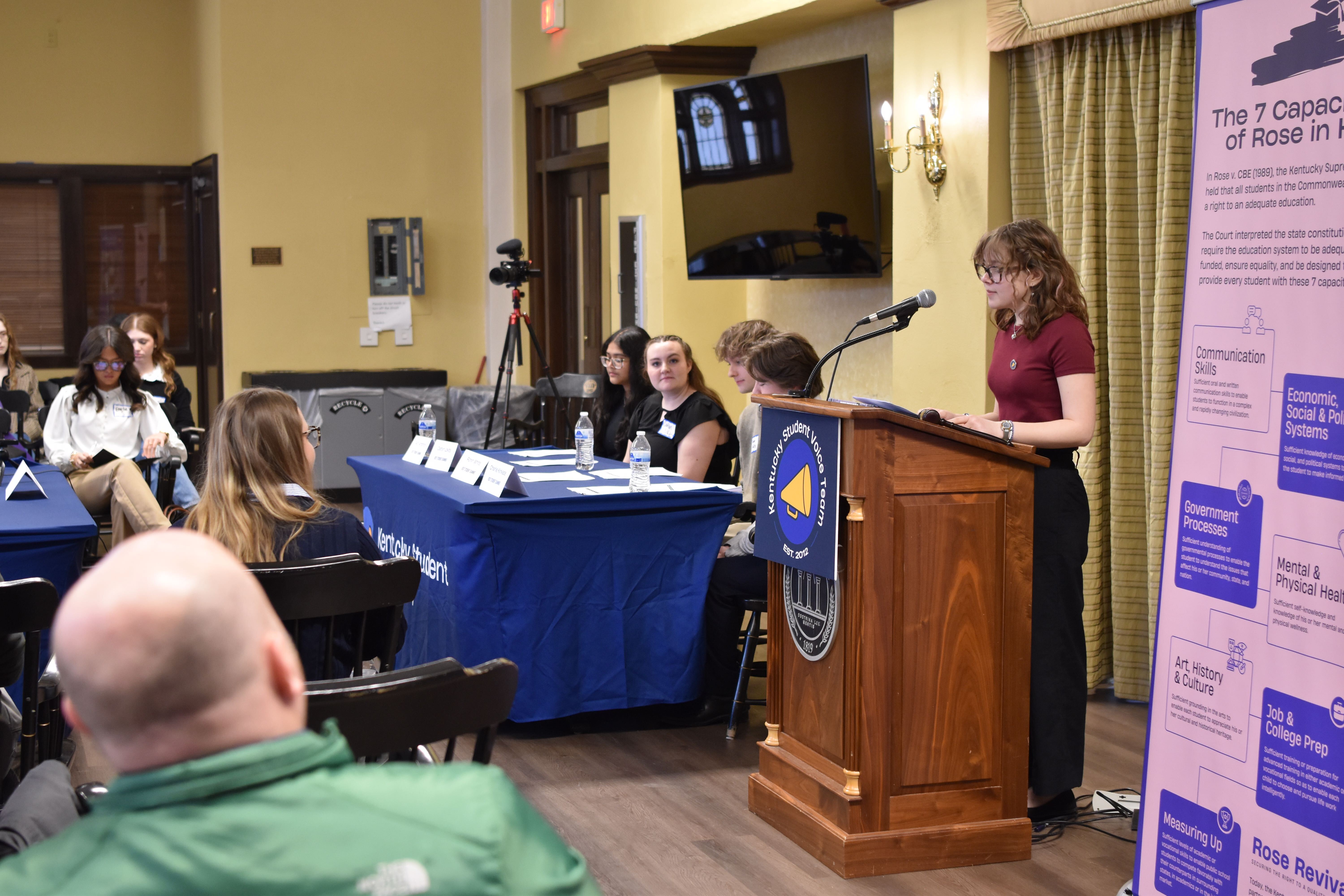
On March 19, 2025 I organized and led a youth roundtable, bringing together students from Boyle and Danville high schools to reflect on their experiences with arts education. As part of my fellowship with Citizen University’s Youth Collaboratory program, I was supported to design a civic “power project” that centered student voice. The community event I organized was a power project with a mission of uniting student artists across school districts and highlighting their stories. With the support of the Art Center of the Bluegrass and the Kentucky Student Voice Team, two other students, Abigail Sears and Charlie Kinkade from Danville High School, and I facilitated roundtable groups where the 15 students in attendance shared about their arts-related journeys. (The student quotes used in this piece are from discussions during that roundtable, and have been lightly edited for clarity.)
“I think arts education is really underappreciated. I don't think a lot of people value it or think that it leads to anything important in life, even though that is not true whatsoever,” says Lucy Kneisley, a Danville student, when it comes to the value of arts in our society.
As of the 2026 legislative session, bills that would affect school funding indirectly and directly, such as HB 500, have been introduced. On a state level, in January 2025, the Kentucky Department of Education revealed shortfall of more than $40 million in the Support Education Excellence in Kentucky, or SEEK, funding formula. And when funding obstacles arise, schools are most at risk of removing arts programs. For example, in 2024, the Fayette County Public School Board upheld its decision to cut the Cassidy Elementary School art program due to budget concerns, after turning down an appeal made by parents. Additionally, in March 2026, Georgetown Middle School’s Site Based Decision Making Council voted to cut choir and band teaching positions, despite opposition from over a dozen community members.
Statewide challenges like these were echoed in roundtable discussions about the future of the arts in schools. Students in the Danville community believe arts education is important to our area. “I think Danville really values art. In English classes, they'll incorporate art projects and such or will read artistic literature. They have photography, a yearbook, and a newspaper. We have the Arts Hall of Fame, too. There are murals everywhere…and I just think it's very well-valued,” says Lilly Bratcher, a Danville student.
The Boyle County Arts Academy
In the Danville-Boyle County art community, there are various programs available to students. For example, in 2022, the Boyle County Arts Academy (BCPAC) launched its first year, offering arts students opportunities to enhance their preferred future field. Some of the opportunities available to arts academy students include 30 different arts electives at the middle and high school levels, dance classes, individualized class scheduling, and an Arts Seal of Excellence.
“What I've seen in these three years is tremendous growth in interest and participation in the arts. I think for a district our size, we have a robust amount of offerings. I mean, find another district our size that has a certified dance teacher offered from 5th to 12th grade. Same thing with theater, beginning to be offered in elementary,” said BCPAC Director, Jimmy Cornn.
While Boyle County has been making great advances in arts education in recent years, Danville High School has a long-standing history of theater involvement, and they have led show productions since the 1940s.
“Our goal for the visual and performing arts programs at the Danville Schools has always been to provide high quality arts experiences for all students,” Jane Dewey, the Director of Arts Education at Danville High School, said in an interview with The New Edu.
“There are a lot of opportunities just outside of school. The Arts Academy gives you opportunities to hear professionals if you're in music and gives you opportunities for workshops, like if you're into visual art. It gives you a lot of opportunities. It is just a really nice program overall—I love it,” said Magen Bates, a Boyle County student.
Some students feel like the Arts Academy at Boyle County could be more adaptable. “The Arts Academy is a great pathway, but it's kind of limiting. If you value your academics as much as you do your creativity, it's kind of hard to balance that out. I know for my senior year, I was contemplating the government class but also the AP art class. And because the schedules are very rigid, you can't really overlap anything,” adds Finn Stocker. Schedule inflexibility is a challenge for arts students in many schools as course requirements vary among districts.
Other students spoke on the variety of arts-related activities they can be involved in. According to Abbie Pennington, Danville students have access to programs like Admiral U, a free Thursday art class where students can express themselves creatively.
Educators address the necessity of arts education
In interviews with The New Edu, educators also spoke of the importance of arts education, and how that shows up in their district. “We have equal instructional time for the arts, often, art classes are seen as less crucial and can be the first to be cut or have their time reduced. Giving art the same weight and time allocation as other core subjects signals its importance,” Danville High School Arts teacher Shelly Stinnett said.
“I find it unfortunate that when it comes to cutting costs in public education, the arts is often the first place people look. I hope our school district continues to support the arts in every way possible,” Danielle Burke, an English and Creative Writing teacher at Boyle County High School, said.
“When you look back at antiquity, the times that we prop up as a pinnacle of human enlightenment are when the arts are prospering. The Renaissance isn't the Renaissance without its paintings; the ancient Greek world is not the ancient Greek world without its plays,” Technical Theatre Director at Boyle, Kolton Winfield, pointed out, validating the significance of the arts throughout history and society.
The importance of the arts
Arts education is an important issue in our current social and political environment. Despite arts and culture contributing over 1.1 trillion to the U.S. economy in the past year, public funding for the arts has faced cuts, and arts appropriations are expected to drop by 10% this year. The Trump administration cut over $1 billion in federal funding from the Corporation for Public Broadcasting, and later, CPB’s board voted to disband. This resulted in budget reductions for both PBS and NPR, both vital sources of arts and culture coverage. Last year, arts organizations had grants terminated after the Trump administration’s attempts to eliminate the National Endowment for the Arts from the federal budget.
Even beyond the wider arts and culture landscape, many express needing more support for arts education.
On February 21st of this year, the Kentucky Student Voice Team hosted a public hearing centered on arts education, a great opportunity for community members to support the arts and students. The expert witness testimonies included insights such as arts classes being the first to go during school budget cuts, and the arts being a primary motivator for many students to be present at schools. Additionally, some witnesses viewed the arts as a tool to teach socioemotional development and noted a lack of accountability models in education to assess arts curriculums.
We can all work towards making a difference in the arts world. Seeking to develop an education pathway in the performing arts, donating to arts nonprofits, like some museums and galleries, that align with your values, subscribing to art magazines to stay informed about current events, or organizing community events are just some of the ways one can support arts programming. Engaging with art is a form of civic engagement, and as students and educators make clear, we need more support for this work in schools.


.png)

.jpeg)